
AI Powered Battery Fitness Assessment
National Hackathon · NeGD · MeitY · MYAS
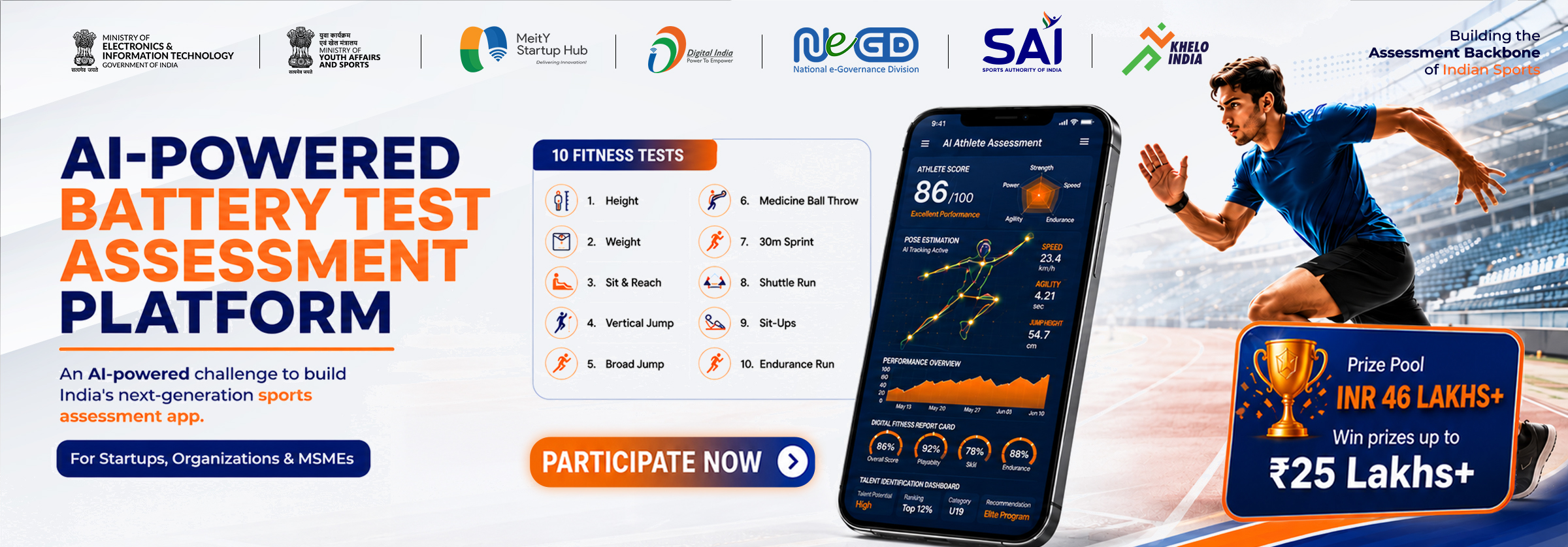
This initiative sets out to develop an AI-assisted Battery Test Application that digitises India’s 10 Battery Fitness Assessment Tests using mobile technology and AI video analytics — replacing a manual, resource-intensive process with an intelligent, scalable tool built for the grassroots.
Today, all 10 Battery Fitness Assessment Tests are conducted and recorded entirely by hand, making the process resource-intensive, inconsistent and difficult to scale. The app must work reliably on basic Android smartphones, including in rural areas with limited infrastructure.
Built through the Unified Digital Sports Ecosystem programme, the app is designed to serve as the foundational entry point of India’s athlete-development pipeline — helping every child, in every district, get identified, assessed and nurtured through objective, data-backed evidence.
Participants are free to propose any technology architecture, AI methodology or hardware approach that best achieves the goals of the challenge. The programme does not prescribe specific tools — it seeks innovative, scalable and practically deployable solutions.
Intended users span PE teachers and students across more than 1 lakh schools, Talent Identification & Development / Zonal Committees (TIDC/TIZC), and coaches at Akhaadas, STCs and NCOEs — covering the entire athlete development pipeline from screening to selection.
Every test is powered by on-device AI and video analytics — detecting take-off, landing, rep completion or line-crossing events and converting them directly into a measurement, removing assessor reaction-time error and manual entry.
A coach in a village with no internet signal must be able to register athletes, record all 10 tests, view results and generate a digital report card entirely offline — with data syncing automatically once the phone reconnects.
Eight capabilities every submission is expected to demonstrate, spanning measurement, access and governance.
Every test has a defined physical quality it measures, a standard protocol, and a production accuracy target. Full procedures are provided in the Technical Handbook.
Standing height, feet to top of head — within ±1 cm without a stadiometer.
Scale-based entry with optional OCR assist and auto-calculated BMI.
Seated forward reach; best attempt auto-selected across trials, within ±2 cm.
Take-off and landing detection computes jump height within ±2 cm.
Contactless horizontal distance measurement from take-off line to landing.
Backward overhead throw distance, release to first landing, within ±5 cm.
Automatic start and finish detection eliminates stopwatch reaction error.
4×10m turn detection with total time and per-leg splits.
Valid rep counting within a timed window, at ≥95% counting accuracy.
800m (U-12) or 1.6km (12+) with auto-start and auto-finish detection.
Applications open on 13th July 2026 and close in the first week of August 2026. Further dates will be confirmed on the official challenge page.
Registration opens for teams and individual innovators nationwide.
Last date to register a team for the challenge. Late entries will not be accepted.
The evaluation committee reviews submissions against the approach and honest evidence provided by each team.
Officially shortlisted by SAI & NeGD. Each shortlisted startup receives a ₹1,00,000 Prototype Development Grant.
Activity 2 begins after grant initiation and participation confirmation.
Results are announced and winning teams are notified via the official challenge portal.
Read these before you begin building. The Concept Note is the primary reference for the entire challenge.
The full Concept Note & Participant Guide (v3.0) covering context, the 10 tests, per-test expectations, constraints and the production vision.
View PDFEvery artifact your team must submit for final evaluation — application build, source code, architecture documents, model cards and more.
View PDFOfficial test protocols for all 10 battery assessment tests — equipment, setup, starting positions and number of attempts. Provided as Annexure A of the Concept Note.
View PDFReach out to the MSH Team for any technical questions about the challenge, submission process or platform requirements.